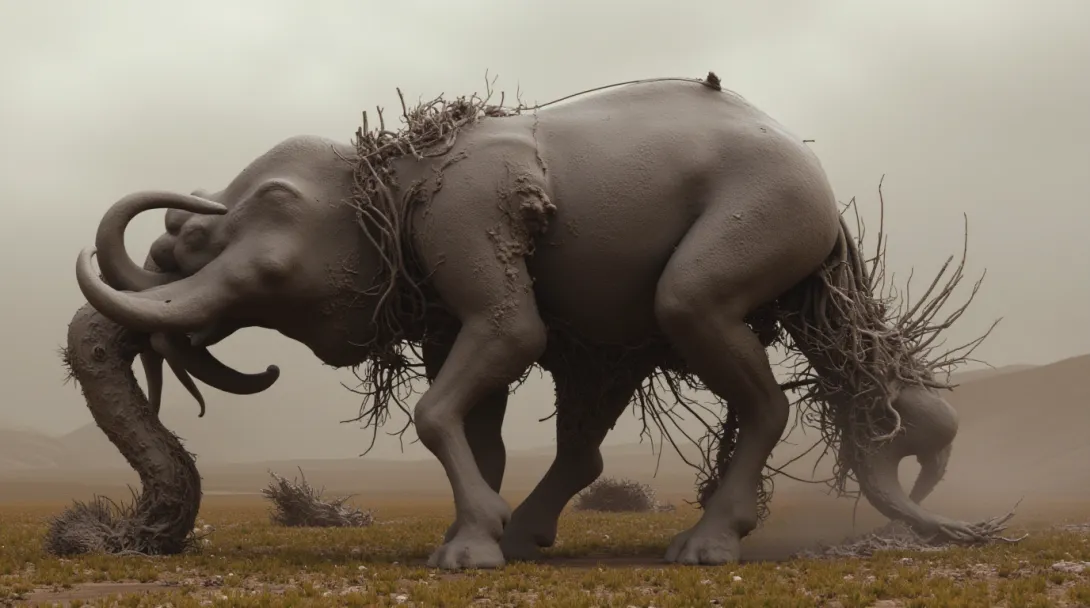
Deeply entangled in a complex web of fortunate circumstances, exposure to precisely the right great ideas of millennia spanning lineages of intellectual giants, access to basic commodities, time, genetic fortune, favourable zeitgeist and advantageous market conditions, among an incalculable plethora of decisive prerequisites, a brown field market grazer hatchling is nursed by a small but steady stream of seed funding, friends and family donations, and perhaps some, mostly but not necessarily entirely, opportunistic, support from publicly funded institutions whose employees are driven to constantly associate their organisations, and thereby, internally, themselves and their personal careers with the innovations of others in exchange for what mostly amounts to quite little, and sometimes nothing.
The hatchling's societal role is that of a start-up company. Inside its tiny, dark, shapeless body a faint light of ingenuity and entrepreneurship emanates from a life form, that has already started to build its own prison around itself. A dungeon from which it must ultimately escape, lest it shall remain bound and paralysed until it fades away forever. This lifeform is the start-up's founders, whom together constitute a captured pollinator, stuck and transformed into the central nervous system of another, surrounding, organism.
From a corporate point of view, which, by the way, is a subview of a broader societal point of view, the grazer hatchling is a productification project, tied to a new company founded for this purpose, where the fruits of a spurious seminal innovation are slowly encapsulated in an unstructured web of immature business models, sales agreements, arguments over ownership, poorly planned and negotiated supplier relationships and other vital anatomic structure, forming the grazer's embryonic backbone. The first reminiscence of a value chain is taking shape inside the juvenile legal entity.
The grazer hatchling's value creating backbone is weak and poorly adapted to a life in the corporate wilderness. Nevertheless, if the would-be pestuous economic parasite is fortunate enough to have been spawned in a green field market, this emerging anatomical structure might just be functional enough to allow its slender, trembling proboscides to sustain its hatchling body with enough nourishment, gathered from wherever they are sufficiently long and sharp to penetrate a market segment, for it to continue growing and attract symbiotic financial institutions to infest it with a fortuitous enough blend of nutrients and poison to enter its first metamorphosis, where it sheds its initial cadre of barely competent friends of the founders, and replaces them with mediocre white-collar workers. A grazer that is lucky enough to survive this long, torturous and expensive process has reached juvenility.
From this point in time, the brown field market grazer aimlessly roams its ever fading, now brown and dusty, pastoral birth place, to which it is forever bound by both instinct and constitution. Here, it will slowly grow, while gradually killing its environment, until it reaches its final developmental phase, its final metamorphosis, during which whatever remnants are still left of its trapped and paralysed pollinators are finally able to make their escape, their exit, and the grazer turns into a herd animal. It becomes part of a corporation, or makes its initial public offering.
Corporate boards, management groups and the profligate rabble often referred to as the traders of the stock exchange, the herders, sometimes try to mate, merge or genetically alter mature grazers, albeit always in vein, as brown field market grazers are innately sterile animals. The law of the vital few acts as an immune system, driving away or killing any productive employee cell in its crooked body. Its scattered spots of nervous tissue are structurally incapable of developing any coherent, centralized perceptive or cognitive capabilities, and the inevitable earnings-related KPI's, seeping though its veins, contracted from its passive and impotent owner institutions, via its corporate boards and management teams, counteracts any attempt of cross-sales or serious allocation of resources for innovation, as that leads to middle management extracellular structures, holding the grazing beast together, to trigger autoimmune responses, rendering any risk-taking body cannibalized by its surrounding managerial structures, which have taken less risk, and instinctively attacks any external decrease in earnings with slander and underhanded disservices while using its more inert, and therefore temporarily larger, resources to devour any spoils left, once the atrophied risk taker can no longer defend him- or herself. The only truly fruitful endeavours a herder of brown field market grazers can engage in are new acquisitions and culling of the herd.
The mature brown field market grazer is, however, a durable creature. It has a tremendous capacity to grow new proboscides to further leach upon its already dying hosts. Its employee cells, while unproductive and poorly motivated, will survive extreme lack of direction and purpose, as long as they can buy the same extras package for their cars as their pesky neighbors, get to play PADEL during lunch break, and leave early on Fridays. Its non-performing constitution automatically sanitizes any inclination towards evolution as non-productive middle managers effectively quell all endeavours of excellence with their inability and disinterest in supporting such activities, and an inviolable drive to actively undermine more dynamic manifestations of such phenomena, since any increase in productivity, within their managed domain threatens their ingrained ineffectual habits with a need for actual work on their own part, to properly follow up its evolution.
This almost complete lack of defining constraints on the brown grazer's shape, along with its massive assemblage of questionable, but muck absorbent support functions, like internalized IT, HR, Communications and DEI departments, allows it to sustain extreme shocks in terms of unprofitable, or even directly economically harmfull pressures from parasitic interest groups, political debauchery and internal power feuds.
Ironically, this might be the reason why the brown field market grazers and their herding corporate management teams make up such a large part of the global free market. Perhaps even more counter-intuitive, their presence could in fact have a stabilizing effect on society as a whole, as they appear to provide enough context and routine for a sufficiently large part of the, statistically speaking, roughly 80% of the earth's population whose actions - shaped by local incentives and constraints - are not directed toward producing significant value beyond their immediate context, for them to, to a historically record low extent, not indiscriminately rape, pillage and bash each other’s and everybody else’s heads in, wherever grazer corporations are abundant.
What if, however, there was a way to alter the fate of the captured pollinator? Could there be a way to, ever so slightly, alter the course of it's self-imprisoning evolution, such that its natural pollinating instinct and prowess would instead instantly, continuously augmented by the nourishment it receives from it's early revenue and funding, be able to continue its natural behavior? Could it even be done in such a way that the pollinator does not have to strain its natural environment to an extent to which it eventually completely devours its own habitat, like its would-be ancestor, the brown field market grazer, in order to survive?
Perhaps, the answer lies in a kind of bee-keeping alternative to herding, where the pollinators are grown and nurtured, in prolific green field market areas, and where they are provided with just enough infrastructure for them to escape immediate capture and leave a pollinated organism behind, before they fuse and are turned into another brown field market grazing abomination, in such a way that the bee keepers can harvest their honey?
The challenge here, might lie in the central intrinsic conflict of interest such a system inevitably carries with it. Pollinators, can only remain in a hive as pollinators during the early stages of their development. As they mature, they must themselves be allowed to become bee-keepers, or they will escape and continue their life in solitude.
Perhaps, if one could find a way to provide an evolutionary path for pollinators to, in a meritocratic way, and in due course, develop into partners of a collaborative bee-keeping context? Could the success of such an organism allow healthier and more diverse green field market ecosystems to emerge from the ashes of an extinct tyranny of brown field market grazers?
Comments